By Brenda Wereh09 Jul, 202538 mins read 2,403 views
0 comments 0 likes
A popular TikToker has been arrested after a video surfaced online allegedly inciting violence against police during the Saba Saba protests. Authorities warn of legal action against digital incitement and hate speech.
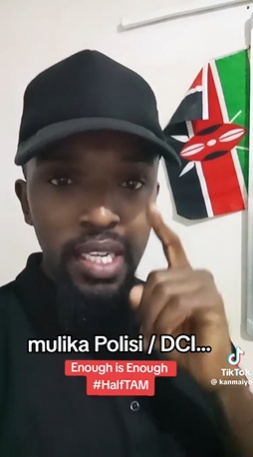
In a dramatic turn of events that has sparked widespread debate, Nairobi-based TikToker Godfrey Mwasiaga Kakan Maiyo was arrested on July 9, 2025, by plainclothes detectives from the Directorate of Criminal Investigation (DCI) in Kenya. The arrest, which was captured on video and quickly went viral, stemmed from allegations that Maiyo posted a TikTok video inciting violence against police officers and their families.
This incident has reignited discussions about the boundaries of free speech, the role of social media in activism, and the tensions between law enforcement and citizens in Kenya. This article delves into the details of the arrest, the context of Maiyo’s content, the legal implications, and the broader societal impact of this high-profile case.
On the evening of July 9, 2025, Godfrey Mwasiaga Kakan Maiyo, known on TikTok as @kanmaiyo, was apprehended at his workplace in Nairobi. A chilling video shared by activist Cyprian Nyakundi captured the moment plainclothes officers confronted Maiyo, leading to a struggle as he resisted being taken into custody. In the footage, Maiyo is heard cautioning the officers to handle him carefully, citing the risk of electrical shock, though the exact context of this statement remains unclear. The video’s raw intensity, showing Maiyo’s resistance and the officers’ forceful response, quickly spread across social media platforms, amplifying public interest and outrage.
The DCI announced Maiyo’s arrest shortly after the video surfaced, stating that he was detained for allegedly uploading a TikTok video that incited violence against police officers and their families. While the specific video in question was not publicly identified by the DCI, a review of Maiyo’s TikTok account revealed a recent four-minute clip where he directly addressed the investigative agency. In this video, Maiyo criticized the DCI for what he described as the abductions of unarmed Kenyans and urged officers to resist being manipulated by higher authorities. This content, which aligns with Maiyo’s broader commentary on police brutality and governance failures, is believed to be the catalyst for his arrest.
Maiyo, a businessman and logistics company owner with over 25,000 TikTok followers, has built a significant online presence by addressing social and political issues in Kenya. His arrest has drawn comparisons to other cases where social media influencers have faced legal repercussions for their online activities, raising questions about the balance between freedom of expression and legal accountability.
The Context of Maiyo’s Content
Godfrey Mwasiaga Kakan Maiyo is not a stranger to controversy. His TikTok platform has been a space for outspoken critiques of systemic issues in Kenya, particularly police brutality and governance failures. With a follower base exceeding 25,000, Maiyo has leveraged his influence to highlight instances of alleged police misconduct, often calling out specific actions by law enforcement that he perceives as unjust. His content resonates with a segment of the Kenyan population frustrated by perceived abuses of power and lack of accountability within the government and police force.
The specific video that led to Maiyo’s arrest reportedly contained strong language directed at the DCI, urging officers to refrain from participating in what he described as unlawful abductions. While the DCI claims the video incited violence against police officers and their families, supporters of Maiyo argue that his content was a call for accountability rather than a direct incitement to violence. This distinction lies at the heart of the debate surrounding his arrest, as it touches on the fine line between activism and incitement under Kenyan law.
Kenya has a history of cracking down on social media content deemed inflammatory or threatening to public order. The Cybercrime Act, often cited in such cases, provides law enforcement with broad powers to arrest individuals for content that could be interpreted as inciting violence or undermining public safety. Maiyo’s case is not isolated; other Kenyans, including X users and software developers, have faced arrests for contravening this law by posting content critical of the government or police. For instance, individuals creating silhouette caricatures of politicians or websites exposing governance issues have been targeted under similar pretexts.
Legal Implications and Charges
Maiyo is currently in police custody, undergoing processing as he awaits arraignment in court. The DCI has not disclosed the precise charges but has indicated that they relate to incitement of violence, likely under the provisions of the Cybercrime Act or related legislation. In Kenya, incitement to violence is a serious offense, carrying potential penalties of fines, imprisonment, or both, depending on the severity of the case and the evidence presented.
The lack of clarity regarding the specific video in question has fueled speculation and criticism. Legal experts argue that for a charge of incitement to hold, the prosecution must demonstrate that Maiyo’s content explicitly called for violent acts and posed a direct threat to public safety. If the video merely criticized police actions without a clear call to violence, Maiyo’s defense could argue that his arrest infringes on his constitutional right to free speech, as enshrined in Kenya’s 2010 Constitution.
The arrest also raises questions about the enforcement of cybercrime laws in Kenya. Critics of the Cybercrime Act have long argued that its vague language allows authorities to target dissenting voices under the guise of maintaining public order. Maiyo’s case could become a litmus test for how Kenya balances freedom of expression with the need to prevent harmful content online. As he awaits his court appearance, legal analysts and human rights organizations are closely monitoring the case for potential violations of due process or overreach by law enforcement.
Societal Impact and Public Reaction
The arrest of Kakan Maiyo has sparked a polarized response in Kenya and beyond. Supporters view him as a courageous voice speaking out against systemic injustices, while critics, including some law enforcement officials, argue that his rhetoric crossed a line into dangerous territory. Social media platforms, particularly X, have been abuzz with reactions, with hashtags like #FreeKakanMaiyo trending in the hours following his arrest.
Posts on X reflect the divided sentiment. For instance, a post from @DCI_Kenya announced Maiyo’s arrest, emphasizing the allegations of inciting violence, while users like @Kenyans and @NationFmKE echoed the official narrative. However, other users, including @felix_asoha and @KotFM_KE, expressed skepticism, framing the arrest as an attempt to silence a vocal critic of police misconduct. The viral video of Maiyo’s arrest, shared by Cyprian Nyakundi, has further fueled public outrage, with many questioning the aggressive manner in which he was apprehended.
This incident is part of a broader global trend where social media influencers face legal consequences for their online activities. In Pakistan, for example, TikToker Kashif Zameer was arrested in early July 2025 for displaying firearms in a viral video, violating laws aimed at preventing violence during Muharram. Similarly, in Venezuela, a TikTok influencer was murdered during a livestream after denouncing organized crime, highlighting the risks faced by those who challenge powerful institutions. These cases underscore the precarious position of social media activists, who often operate in a gray area between free speech and legal boundaries.
In Kenya, the arrest has reignited debates about police reform and accountability. The country has faced recurring protests over alleged police brutality, particularly following the 2020 lockdown measures and the 2024 anti-government demonstrations. Maiyo’s content, which often addresses these issues, resonates with a younger demographic that feels marginalized by the political and law enforcement establishment. His arrest could galvanize further activism or, conversely, deter others from speaking out for fear of similar repercussions.
The Role of Social Media in Activism
Social media platforms like TikTok have become powerful tools for activism, allowing individuals like Maiyo to reach large audiences with minimal resources. TikTok’s short-form video format is particularly effective for spreading messages quickly, making it a popular platform for political commentary in Kenya. However, the platform’s accessibility also makes it a target for scrutiny by authorities, who view viral content as a potential threat to public order.
Maiyo’s case highlights the double-edged nature of social media activism. On one hand, it provides a platform for marginalized voices to challenge systemic issues; on the other, it exposes creators to legal and personal risks. The viral nature of Maiyo’s arrest video demonstrates how quickly content can spread, amplifying both the message and the consequences. As social media continues to shape public discourse, governments worldwide are grappling with how to regulate it without stifling free expression.
The arrest of Godfrey Mwasiaga Kakan Maiyo on July 9, 2025, marks a significant moment in the ongoing tension between social media activism and state authority in Kenya. While the DCI claims that Maiyo’s TikTok video incited violence against police officers, his supporters argue that he was exercising his right to free speech by calling for accountability. The viral video of his arrest has only intensified the debate, drawing attention to issues of police conduct, cybercrime laws, and the role of social media in modern activism.
As Maiyo awaits his day in court, his case will likely serve as a flashpoint for discussions about the limits of free expression in Kenya. It also underscores the challenges faced by social media influencers who use their platforms to critique those in power. Whether Maiyo’s arrest is seen as a justified response to dangerous rhetoric or an overreach by authorities, it highlights the complex interplay between technology, law, and societal change in the digital age. As the story continues to unfold, it will undoubtedly shape the future of online activism in Kenya and beyond.
Former Kiambu Governor Ferdinand Waititu has secured a major bail reprieve from the High Court, with Justice Winfrida Okwany reducing his bail from Sh53.5 million to Sh20 million cash pending appeal in his ongoing corruption case.
President Ruto and Governor Sakaja signed a cooperation agreement allocating funds for 50,000 new streetlights, water plants saving 50 million litres daily, 27 km Nairobi River sewer and ward road upgrades, with Ruto calling it a partnership to make the city livable while opposition senators warn of devolution threats.
A staff member at Moi Teaching and Referral Hospital allegedly stole Sh10 million by falsifying patient bills as paid in the eCitizen system while diverting the money to her personal account, prompting an ongoing police and hospital investigation.