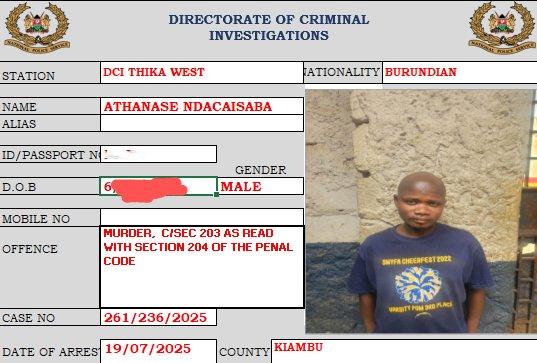
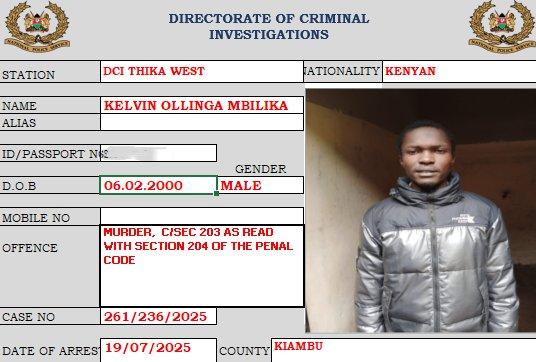
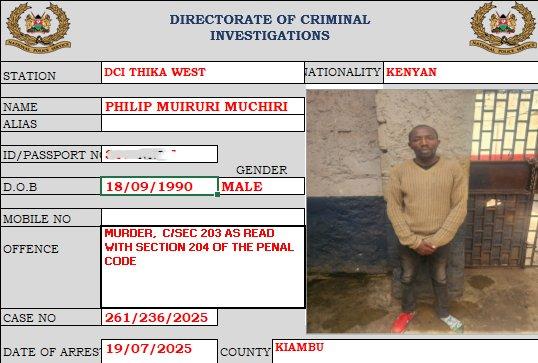
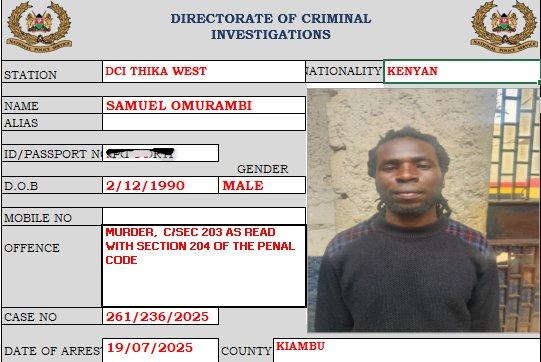
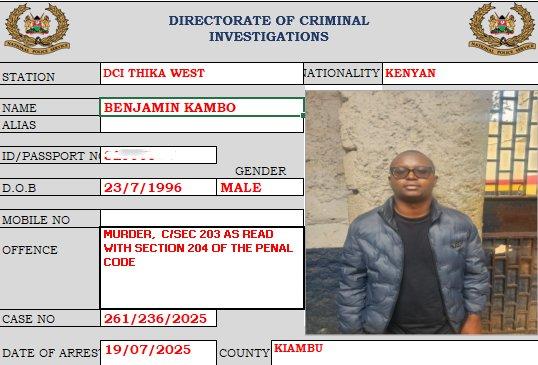
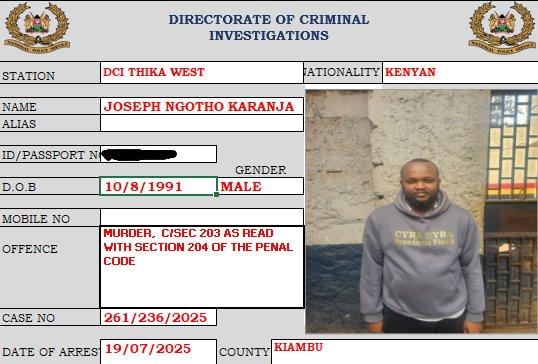
Directorate of Criminal Investigations (DCI) in Kenya announced a significant breakthrough in the investigation of the fatal shooting of Police Constable Bernard Koome, who was killed on June 18, 2025, along the Thika-Garissa Road interchange in Kiambu County. Six suspects, believed to be behind the officer’s death, were apprehended in a carefully coordinated operation in Kahawa West and Kiamumbi, areas within Nairobi and Kiambu counties. The Thika Law Courts subsequently granted the DCI a 21-day detention period to continue investigations, marking a critical step toward justice in a case that has sparked public concern and highlighted the dangers faced by law enforcement officers in Kenya. This article delves into the details of the incident, the arrests, the court’s decision, and the broader implications for public safety and police operations in the region.
The Incident: A Routine Patrol Turns Deadly
The tragic incident occurred on the evening of June 18, 2025, in the Cravers area of Thika West, Kiambu County. Police Constable Bernard Koome, a 32-year-old officer from the Special Police Intercept and Verification (SPIV) unit, was conducting a routine stop-and-search operation along the busy Thika-Garissa Road interchange. According to police reports, Koome and a colleague noticed a motorcycle rider behaving suspiciously. The officers attempted to stop the rider for a routine inspection, noting that the motorcycle lacked the mandatory Thika registration code. When Koome removed the ignition key to prevent the rider from fleeing, a confrontation ensued.
The situation escalated rapidly. The suspect allegedly drew a firearm and shot Koome at close range, striking him in the neck. The assailant then fled the scene on another motorcycle, leaving behind a CZ pistol magazine loaded with four rounds of 9mm ammunition and two spent cartridges. Despite being rushed to Thika Level 5 Hospital, Koome succumbed to his injuries upon arrival. The brazen attack, which occurred in a busy area near the Royale Hotel, sent shockwaves through the local community, with residents like Collins Waweru, a boda boda operator, describing the gunfire as initially mistaken for a terrorist attack. Mary Nduta, a hotel attendant nearby, noted the swift police response, with officers flooding the area within minutes, reflecting the gravity of the incident.
The killing of Constable Koome underscored the risks faced by law enforcement officers in Kenya, particularly those engaged in intelligence-led operations targeting criminal networks. Initial investigations suggested that the suspect was part of a broader criminal ring operating in Thika, Juja, and Ruiru towns, where at least six armed robberies had been reported in the preceding month. The incident also raised questions about the proliferation of illegal firearms and the growing audacity of criminals in the region.
The Investigation: Forensic Leads and a Coordinated Operation
Following Koome’s death, the DCI launched an immediate manhunt, supported by forensic evidence and public cooperation. The recovery of the spent cartridges and the loaded pistol magazine at the crime scene provided critical leads. Over the next month, detectives meticulously analyzed these items, employing advanced forensic techniques to trace the suspects. The investigation led to a hideout in Kahawa West, Nairobi, where five of the suspects were apprehended. A sixth suspect was later tracked down in Kiamumbi, Kiambu County, during a follow-up operation.
The DCI’s operation was described as intelligence-led and carefully coordinated, reflecting the agency’s commitment to leveraging technology and community input to combat crime. In addition to the arrests, authorities seized a vehicle believed to have been used by the suspects during the crime. The DCI credited the breakthrough to “crucial forensic leads” and collaboration with the public, emphasizing the importance of citizen support in solving high-profile cases. Police Spokesperson Muchiri Nyaga reiterated the agency’s resolve, stating, “We are pursuing every lead to ensure those behind this heinous act face justice. The death of Constable Koome was a stark reminder of the sacrifices our officers make daily.”
The arrests represent a significant milestone in the investigation, but the DCI has indicated that the case is far from closed. The 21-day detention period granted by the Thika Law Courts will allow detectives to deepen their inquiries, potentially uncovering additional details about the criminal network and the circumstances surrounding Koome’s death.
The Court’s Decision: A 21-Day Detention Order
On July 21, 2025, the six suspects were arraigned at the Thika Law Courts, where the DCI sought additional time to complete its investigations. The court, presided over by a magistrate, granted the prosecution’s request to detain the suspects for 21 days. This decision was based on the complexity of the case and the need to gather further evidence, including ballistic analysis of the recovered ammunition and potential links to other criminal activities in the region. The detention order ensures that the suspects remain in custody while detectives work to build a watertight case for prosecution.
The court proceedings were conducted amid heightened public interest, with the case drawing attention due to its implications for police safety and public security. The Thika Law Courts have been a focal point for other high-profile cases in recent weeks, including the arraignment of youth arrested during the Saba Saba protests, which sparked emotional reactions and debates over police conduct. However, the Koome case has largely unified public sentiment in support of justice for the fallen officer, with many residents expressing hope that the arrests will deter future attacks on law enforcement.
Broader Context: Police Safety and Public Trust
The killing of Constable Koome and the subsequent arrests occur against a backdrop of ongoing tensions between the Kenyan police and the public. In recent months, the country has witnessed protests over alleged police brutality, particularly following the death of blogger Albert Ojwang in custody in June 2025. Ojwang’s death, initially attributed to self-inflicted injuries but later revealed to be the result of assault, sparked widespread outrage and demonstrations in Nairobi, Mombasa, and other cities. The incident led to the arrest of two police officers and heightened scrutiny of the National Police Service.
These events have fueled a broader debate about police conduct, accountability, and the use of lethal force. Human rights organizations, including Amnesty International and the Independent Policing Oversight Authority, have called for transparency and reforms to address systemic issues within the police force. The Koome case, however, highlights the other side of the coin: the dangers faced by officers in the line of duty. According to Kiambu County Police data, the region has seen a surge in armed robberies, with criminals increasingly using firearms to evade capture. This trend underscores the need for enhanced training, equipment, and support for law enforcement officers.
Public reactions to Koome’s death reflect a mix of grief and frustration. Residents like Collins Waweru have urged authorities to bolster surveillance and address the proliferation of illegal firearms. Others, like Mary Nduta, have expressed reassurance at the swift police response but emphasized the need for long-term solutions to curb violent crime. The arrests in Kahawa West and Kiamumbi have been met with cautious optimism, with many hoping that the investigation will yield convictions and deter future attacks.
Implications for Thika and Beyond
The Thika-Garissa Road interchange, where Koome was killed, is a critical artery connecting Nairobi to northern Kenya. The area’s strategic importance makes it a hotspot for both economic activity and criminal enterprises. The DCI’s success in apprehending the suspects demonstrates the agency’s capacity to tackle organized crime, but it also highlights the challenges of policing a region with a high incidence of armed robberies and gang activity. The recovery of a vehicle and ammunition suggests that the suspects may be linked to a larger network, raising questions about the scope of criminal operations in Thika and its environs.
The case also has broader implications for public safety and police-community relations. The loss of Constable Koome, described as a dedicated officer, has prompted calls for better protection for law enforcement personnel, including improved intelligence-sharing and access to protective gear. At the same time, the public’s demand for accountability in cases of police misconduct remains strong, creating a delicate balance for authorities. The DCI’s emphasis on forensic evidence and public cooperation in this case could serve as a model for future investigations, fostering trust between the police and the communities they serve.
A Step Toward Justice
The arrest of six suspects in the killing of Police Constable Bernard Koome marks a significant step toward justice, but the road ahead remains complex. The 21-day detention period will allow the DCI to gather additional evidence, potentially uncovering the full extent of the criminal network responsible for the officer’s death. As the investigation continues, the case serves as a sobering reminder of the sacrifices made by law enforcement officers and the challenges of maintaining security in a region plagued by violent crime.
For the residents of Thika and Kiambu County, the arrests offer hope that justice will be served. However, the incident also underscores the need for systemic reforms to address the root causes of crime, including poverty, unemployment, and the easy availability of illegal firearms. As the Thika Law Courts prepare to hear the case in the coming weeks, the nation watches closely, hoping for a resolution that honors Constable Koome’s memory and strengthens the rule of law in Kenya.