By Brenda Wereh08 Aug, 202523 mins read 2,429 views
0 comments 0 likes
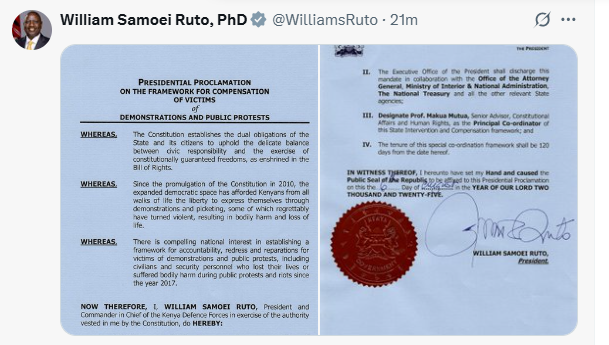
President William Ruto established a 120-day coordinating framework to compensate victims of demonstrations, with Prof Makau Mutua leading the effort alongside key ministries.
A significant development unfolded in Kenya this morning, Friday, August 8, 2025, as President William Ruto announced the establishment of a 120-day coordinating framework aimed at compensating victims of demonstrations and public protests. The proclamation, issued at 11:44 AM East Africa Time from State House, Nairobi, marks a pivotal response to years of unrest that have left civilians and security personnel injured or deceased since 2017. Leading this initiative is Professor Makau Mutua, appointed as the principal coordinator and tasked with collaborating with the Office of the Attorney General, the Ministry of Interior and National Administration, and the National Treasury. The framework seeks to create a structured process for identifying victims and disbursing reparations, addressing a long-standing demand for accountability. A teacher in Kisumu, preparing lessons, remarked, "This could bring some justice if they do it right."
The announcement comes amid a backdrop of recurring protests, notably the 2023 anti-government demonstrations led by the opposition, which resulted in numerous casualties and injuries. Ruto’s decision reflects a shift toward reconciliation, following earlier tensions where he had labeled some protests as treasonous. The 120-day timeline, starting today, underscores the urgency of the task, with Mutua’s role drawing on his expertise as Senior Advisor on Constitutional Affairs and Human Rights. In Nakuru, a farmer irrigating his fields listened to the radio and said, "It’s about time they recognize our losses." The framework’s collaborative approach with key ministries aims to ensure a thorough and transparent process, though details on funding and victim verification remain pending.
Public reaction across Kenya has been a blend of hope and skepticism. In Mombasa, a shopkeeper serving customers caught the news on a nearby radio, noting, "If they compensate fairly, it might heal some wounds." The protests, often triggered by economic hardships and governance issues, have left families grappling with loss, making this initiative a potential turning point. Mutua’s appointment, given his past association with opposition figures, has sparked debate about his impartiality, yet many see his legal background as an asset. A youth leader in Naivasha, organizing a community meeting, added, "We’ll watch to see if this is real or just talk." The framework’s success hinges on its ability to identify victims accurately, a challenge given the scale of past unrest.
The process will involve establishing criteria for victim identification, a task Mutua will oversee with support from the Attorney General, who will provide legal guidance, the Interior Ministry, which will handle security-related data, and the Treasury, responsible for allocating funds. In Eldoret, a driver fueling his matatu expressed cautious optimism, "If they find my cousin’s killer, I’ll believe it." The initiative covers incidents since 2017, including clashes during elections and economic protests, affecting both civilians and security officers. A mother in Nyeri, feeding her children, said, "My brother was hurt in 2023; I hope they find him," as she cleared the table. The collaborative effort aims to balance redress with fiscal responsibility amid a Sh10 trillion public debt.
The morning’s announcement drew varied responses. In Thika, a father waiting at a clinic said, "This could help my friend’s family who lost someone." In Baringo, a community elder leading a discussion noted, "We need proof they’ll follow through." Mutua’s team will develop structures for claims processing, a complex task given the lack of centralized records from past incidents. The Interior Ministry’s role includes verifying security personnel casualties, while the Treasury will determine compensation amounts, likely drawing on existing budgets or new allocations. A health worker in Kisii, coordinating a vaccination drive, added, "It’s a start, but we need details." The framework’s transparency will be critical to gaining public trust.
As the day progressed, the story reached remote areas. In Marsabit, a herder listening to a radio broadcast said, "My nephew was injured; this might help us." In Mombasa’s markets, a vendor packing fish asked, "Will they really pay, or is this another promise?" The 120-day period allows for public input, with Mutua hinting at consultations to ensure inclusivity. The Attorney General’s office will draft legal mechanisms, while the Interior Ministry will compile incident reports, and the Treasury will assess financial feasibility. A student in Nairobi, reading updates online, noted, "People are talking, but we need action." The initiative addresses both physical harm and emotional toll, a comprehensive approach to healing.
The afternoon brought a reflective mood to offices and homes. In Eldoret, a public servant preparing a report said, "This could set a precedent if done well." In Kisumu, a mother checking on her family added, "I lost hope, but maybe now." The framework’s establishment follows years of advocacy by human rights groups, though economic constraints pose challenges. A community organizer in Turkana, planning a radio talk, remarked, "They must include everyone affected." Mutua’s leadership, drawing on his constitutional expertise, aims to navigate these complexities, with the Attorney General ensuring legal compliance and the Treasury managing resources.
Analysts see a strategic move. In Nairobi, a lawyer discussing over tea said, "This could rebuild trust if executed properly." The initiative’s scope includes verifying claims, a process that may involve community testimonies and medical records. A vendor in Timau, closing his stall, said, "Let’s see if the money reaches us." The Interior Ministry’s data will be crucial, while the Treasury’s role will test fiscal priorities. A father in Nyahururu, walking home with his family, added, "If they compensate my neighbor, I’ll support it." The 120-day timeline pressures all parties to act swiftly.
The evening saw continued engagement across the country. In Nakuru, a group at a market debated the news. "Will they find all the victims?" one trader asked, sorting vegetables. In Nairobi’s cyber cafes, a student scrolling through updates noted, "Sentiment is mixed." Mutua’s team plans to hold public forums, ensuring broad participation. The Attorney General will oversee legal frameworks, the Interior Ministry will provide security insights, and the Treasury will finalize funding. A youth leader in Kitale, organizing an event, reflected, "This tests Ruto’s commitment." As Kenya watches, the framework offers a chance for reconciliation.
Former Kiambu Governor Ferdinand Waititu has secured a major bail reprieve from the High Court, with Justice Winfrida Okwany reducing his bail from Sh53.5 million to Sh20 million cash pending appeal in his ongoing corruption case.
Kenya National Highways Authority names Eng. Luka Kipchumba Kimeli as Director General while Kenya Roads Board appoints Judith Otsyula to the same role in major leadership changes for Kenya's roads sector.
Kenya’s Committee on Communication, Information and Innovation has rejected calls for a complete ban on TikTok, instead proposing mandatory local storage of Kenyan user data and full compliance with national laws in a report adopted for debate in the National Assembly.