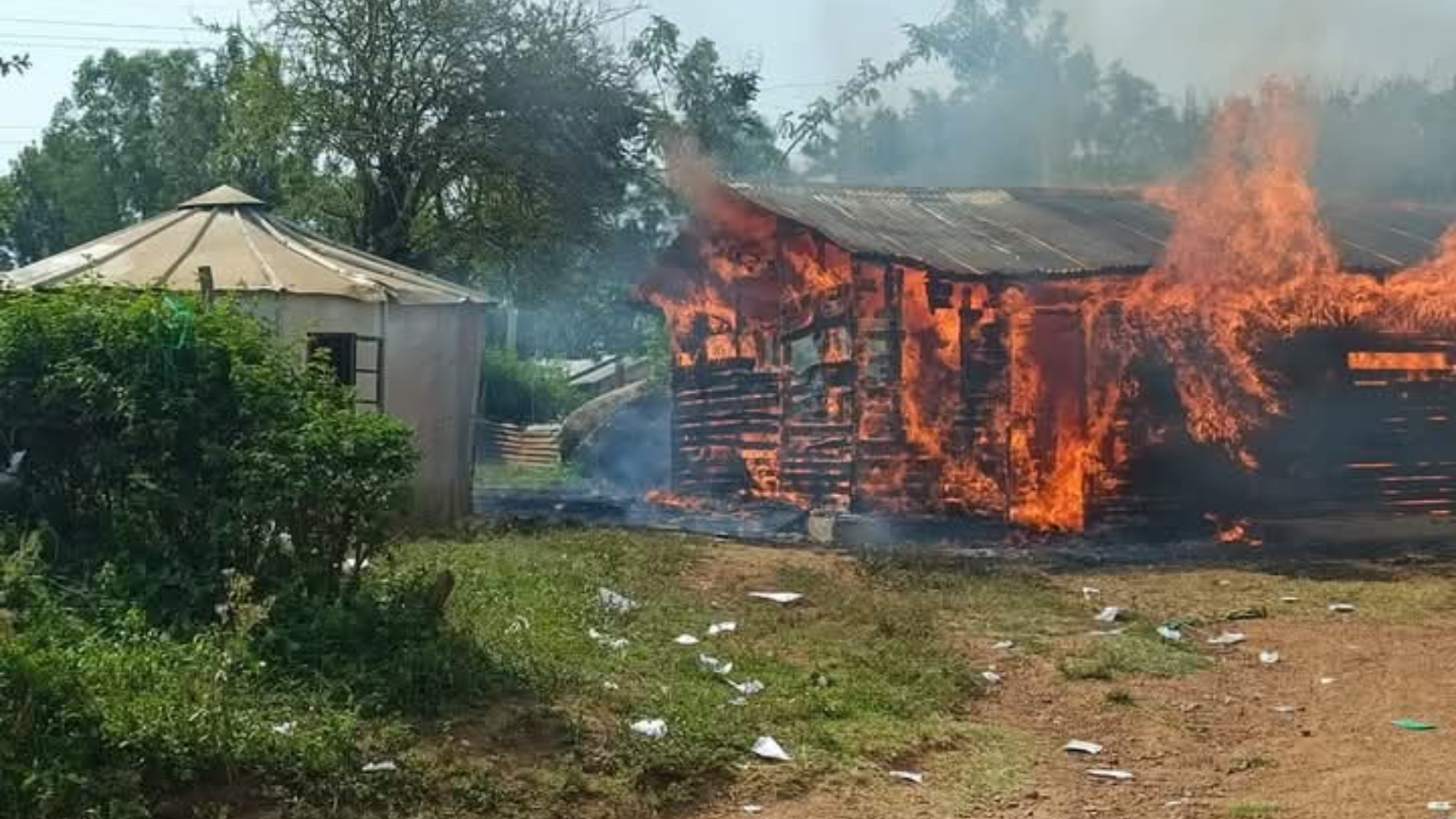
The quiet town of Mawego in Homa Bay County, Kenya, erupted into chaos as thousands of grieving residents, led by enraged youth and students from Mawego National Polytechnic, marched to Mawego Police Station, carrying the coffin of Albert Ojwang, a 31-year-old teacher and blogger who died in police custody under suspicious circumstances. The mourners, chanting “Justice for Albert” and “Stop killing us,” set the station ablaze, reducing parts of it to ashes in a powerful act of defiance against alleged police brutality. Ojwang, arrested on June 7, 2025, for allegedly defaming a senior police official, was transferred from Mawego to Nairobi’s Central Police Station, where he was found dead hours later. The protest, marked by emotional scenes and widespread outrage, has intensified demands for accountability and highlighted Kenya’s ongoing struggle with police impunity.
The procession began early Thursday morning, as Ojwang’s body arrived at Kisumu Airport from Nairobi, where it had been held since his death on June 8. A sea of mourners, including family, friends, and local leaders, lined the dusty roads of Kabondo Kasipul, waving placards and singing dirges. The crowd, dominated by young people, carried twigs and leaves, a traditional Luo symbol of mourning and resistance. Their destination was Mawego Police Station, where Ojwang was briefly detained before his fateful transfer. “We brought Albert here to show the police they can’t escape justice,” said Justus Odhiambo, a student at Mawego National Polytechnic, his voice trembling with anger. “They took him from us, and now they must answer.”
As the mourners reached the station around noon, tensions escalated. Videos captured a mammoth crowd hoisting Ojwang’s casket, draped in a Kenyan flag, while others hurled stones and set fire to the station’s structures. Thick black smoke billowed into the sky as flames consumed parts of the building, including the signage, which protesters uprooted in defiance. Police officers, caught off guard, were seen scrambling to salvage personal belongings or pour water on the burning structures, but their efforts were futile. “The station was completely engulfed,” said a local shopkeeper, who witnessed the chaos. “The youth were angry, and no one could stop them.” The fire, which spread to nearby vegetation, underscored the depth of the community’s grief and frustration.
Ojwang’s death has become a flashpoint in Kenya’s ongoing battle against police brutality. Arrested in Kakoth village on June 7 for allegedly posting defamatory content about Deputy Inspector-General Eliud Lagat on X, Ojwang was held briefly at Mawego Police Station before being driven 350 kilometers to Nairobi. Hours after arriving at Central Police Station, he was found unconscious in his cell and pronounced dead at Mbagathi Hospital. Initial police claims that he died from self-inflicted injuries were debunked by an autopsy conducted by five pathologists, which revealed head trauma, neck compression, and multiple bruises consistent with assault. “My son was tortured,” said Meshack Ojwang, Albert’s father, speaking at a requiem mass held on July 2 at Ridgeways Baptist Church in Nairobi. “They treated him like an animal, and now they must face justice.”
The protest at Mawego Police Station was more than a mourning ritual; it was a bold statement against a system accused of shielding rogue officers. The Independent Policing Oversight Authority has launched an investigation, revealing that CCTV footage at Central Police Station was tampered with on June 8, further fueling suspicions of a cover-up. “The CCTV was deliberately disabled,” said an IPOA official during a June 13 press briefing. “This suggests a planned effort to conceal what happened.” Six officers, including Central Police Station’s Officer Commanding Station Samson Talam and Constable James Mukhwana, face murder charges approved by the Director of Public Prosecutions. The arrests, however, have done little to quell public anger, with many demanding the resignation of Deputy Inspector-General Lagat.
The emotional toll on Ojwang’s family has been profound. At the requiem mass, his mother, Eucabeth Adhiambo, recounted her final moments with her son. “He was trembling when they took him,” she said, tears streaming down her face. “I gave him food, but he never ate it. He told me he’d done nothing wrong.” Ojwang’s widow, Nevinah Onyango, described him as her best friend, recalling their last conversation. “He said, ‘I’ll see you soon,’” she told mourners. “Now I’m left alone, and our world is dark.” The family’s grief has resonated across Kenya, with activists and residents alike linking Ojwang’s death to a broader pattern of extrajudicial killings. “This isn’t just about Albert,” said human rights activist Hussein Khalid. “It’s about the dozens who die in custody every year.”
The Mawego protest has reignited national debates about police reform, particularly as it coincides with the one-year anniversary of the 2024 anti-tax protests, which left over 60 dead and many others missing. President William Ruto, who condemned Ojwang’s death as “heartbreaking and unacceptable,” has promised a transparent investigation, but critics argue his administration has failed to curb police impunity. “Ruto promised change, but we’re still burying our youth,” said a protester in Nairobi, where parallel demonstrations saw police deploy teargas to disperse crowds. The burning of Mawego Police Station has drawn international attention, with the U.S. and EU calling for accountability, citing Kenya’s troubling record of 20 custodial deaths in the past four months alone.
In Homa Bay, fear lingers among residents. “We’re scared to speak out,” said Vida Omondi, a Mawego local. “If they can kill Albert, what about us?” Students at Mawego National Polytechnic, where Ojwang was admired for his outspoken social media presence, expressed similar concerns. “We protest, but we’re afraid we’ll be next,” said Gilbert Okoth, a student. Despite the risks, the community remains defiant, with plans to escort Ojwang’s body to Kokwanyo village for burial on July 4. The funeral is expected to draw thousands, including opposition leader Raila Odinga, who called Ojwang’s death “horrifying” and demanded systemic reforms.
The economic and social fallout from the protest is significant. The destruction of Mawego Police Station has disrupted local security operations, with officers temporarily relocated to nearby facilities. Properties near the station were vandalized, and businesses reported losses amid the chaos. “My shop was looted during the protests,” said a trader in Mawego. “We want justice, but this violence hurts us too.” The government has yet to comment on the station’s destruction, but local leaders are calling for dialogue to prevent further unrest. “We need to channel this anger into solutions,” said a Homa Bay County Assembly member, speaking anonymously.
Ojwang, a former teacher at Mwatate High School and a digital creator known as Pixel Pioneer on X, was celebrated for his commentary on political and social issues. His arrest, linked to posts criticizing Lagat’s alleged involvement in a bribery scandal, highlighted Kenya’s growing crackdown on online dissent. “Albert spoke for the voiceless,” said a fellow blogger in Nairobi. “His death shows they’re scared of our words.” The deletion of Ojwang’s X account after his arrest has raised further questions about evidence tampering, with activists demanding the preservation of digital records.
As investigations continue, the Mawego protest has become a symbol of resistance against police impunity. The Directorate of Criminal Investigations has summoned additional officers from Mawego Police Station for questioning, signaling a broadening probe. “We won’t stop until every officer involved is held accountable,” said Faith Odhiambo, president of the Law Society of Kenya. The case has also drawn comparisons to past incidents, like the 2024 abduction of activists during anti-tax protests, fueling calls for a “total shutdown” of the economy to demand reforms.
For now, Mawego remains tense, with security forces on high alert. The burning of the police station has galvanized Kenya’s youth, who see Ojwang’s death as a call to action. “This is our fight,” said a protester carrying a placard reading “No Justice, No Peace.” As the nation mourns, the push for justice continues, with Ojwang’s legacy inspiring a new wave of activism in a country grappling with the cost of dissent.