By Brenda Wereh01 Aug, 202526 mins read 2,533 views
0 comments 0 likes
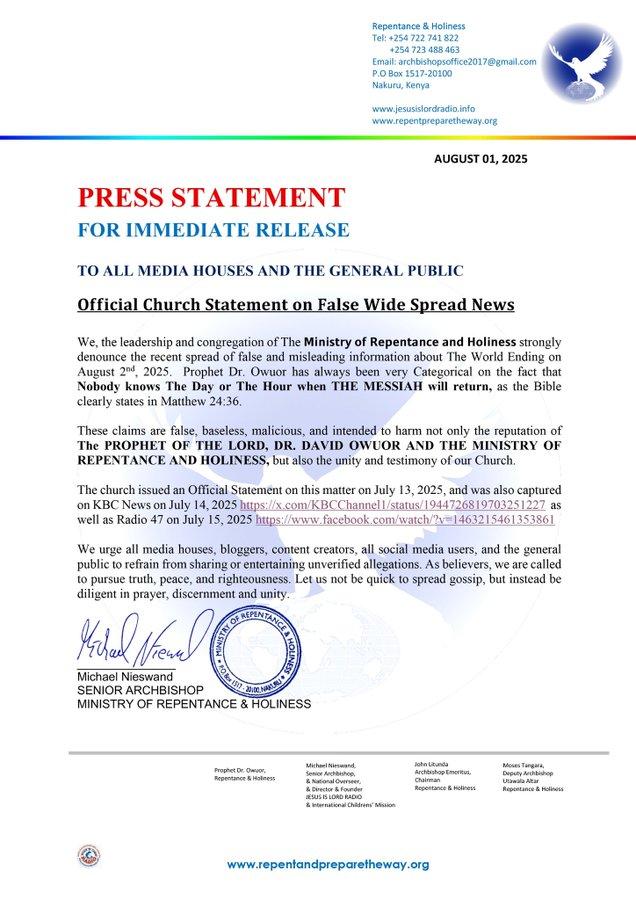
The Ministry of Repentance and Holiness dismissed social media reports alleging Prophet Dr. Owuor declared a Rapture date, labeling them unfounded and misleading.
A wave of concern rippled through Kenya this morning, Friday, August 1, 2025, as the Ministry of Repentance and Holiness moved swiftly to debunk circulating social media reports alleging that Prophet Dr. David Owuor had declared a specific date for the Rapture. The clarification, issued at 11:00 AM East Africa Time through an official statement from the ministry’s Nairobi headquarters, labeled the claims as unfounded, false, and misleading, distancing the organization and its leader from the rumors. The statement came amid a surge of online posts and messages that had sparked anxiety among followers and the public, particularly in religious circles. “These reports do not reflect the teachings or statements of Prophet Dr. Owuor,” a ministry spokesperson said, addressing a gathering of journalists. The move has prompted a mix of relief and scrutiny across the country, with communities grappling with the spread of misinformation.
The rumors, which began gaining traction late Thursday on platforms like X and WhatsApp, suggested that Prophet Owuor, a prominent evangelical figure known for his apocalyptic sermons, had pinpointed a date for the Rapture—a Christian belief in the end-times event where believers ascend to heaven. The claims, often accompanied by vague timelines and dramatic imagery, alarmed followers who associate Owuor with visions of divine judgment. The ministry’s prompt response emphasized that no such declaration had been made, attributing the misinformation to misinterpretations or deliberate fabrications by unknown parties. A teacher in Kisumu, preparing lessons, remarked, “I was worried when I saw those posts, but this clears it up.” The incident highlights the challenges of managing public perception in the digital age, especially amid Kenya’s economic struggles with a Sh10 trillion public debt and 5.5% inflation.
Public reaction has been a blend of gratitude and skepticism. In Mombasa, a shopkeeper serving customers listened to the news on a radio, saying, “I’m glad it’s false, but people believe anything online.” In Nakuru, a farmer irrigating his fields expressed relief. “My family was praying all night; this is good news,” he said, pausing to adjust his equipment. The ministry urged followers to rely on official channels, such as its website and verified social media accounts, for accurate updates, warning against the dangers of unverified information. The Rapture, a topic central to Owuor’s teachings, has long drawn both devotion and criticism, making the rumors particularly potent. A youth leader in Naivasha, organizing a community meeting, added, “We need to teach people how to spot fake news.”
The ministry’s statement outlined steps to address the issue, including plans to issue a recorded sermon from Prophet Owuor reaffirming his stance that the timing of the Rapture remains unknown, a view aligned with mainstream Christian theology. The false claims had spread rapidly, with some posts suggesting dates as early as next month, prompting panic among rural congregations. The ministry accused unnamed individuals of exploiting Owuor’s name for personal gain or to sow discord, a charge that has fueled calls for accountability. A driver in Garissa, fueling his matatu, noted, “If someone’s lying, they should face consequences.” The incident underscores the influence of religious leaders in Kenya, where faith plays a significant role amid economic hardship.
Communities across the country have begun discussing the fallout. In rural Kitale, a herder tending cattle heard a radio update, saying, “Our church was confused; this helps us focus.” In urban Eldoret, a student at a cyber cafe scrolled through reactions, adding, “Social media can ruin trust if not checked.” The ministry plans to hold prayer meetings across major towns this weekend to reassure followers, emphasizing Owuor’s focus on repentance rather than date-setting. The rumors had led some to cancel plans or hoard supplies, reflecting the depth of belief in his prophecies. A mother in Nyeri, feeding her children, expressed relief. “I was scared for my kids, but now we can move on,” she said, clearing the table. The response aims to restore calm.
The morning’s clarification drew diverse reactions. In Thika, a father waiting at a clinic said, “My wife was upset; this eases her mind.” In Baringo, a community elder leading a discussion noted, “We must guide our people away from rumors.” The ministry’s swift action mirrors past efforts to counter misinformation, such as during the 2024 floods when false aid claims circulated. The Rapture, a cornerstone of Owuor’s ministry since its founding in 2004, is presented as a divine mystery, not a scheduled event, aligning with biblical teachings. A health worker in Kisii, coordinating a vaccination drive, added, “This shows the power of official voices in a crisis.” The incident tests the ministry’s communication strategy.
As the day progressed, the story spread to remote areas. In Marsabit, a herder listening to a radio update said, “Our prayers are safe; no need for panic.” In Mombasa’s markets, a vendor packing fish asked, “Who started this lie?” The ministry has called on social media platforms to remove the offending posts, though enforcement remains challenging. The rumors’ spread coincided with heightened religious activity, including Owuor’s recent healing crusades, amplifying their reach. A youth leader in Naivasha, reflecting on the news, said, “We need to protect our faith from these distortions.” The ministry plans a public awareness campaign to educate followers on verifying information.
The afternoon brought a reflective mood to offices and homes. In Eldoret, a public servant preparing a report said, “This could have caused chaos if ignored.” In Kisumu, a mother checking on her family added, “I hope people learn to check facts.” The ministry’s distancing statement included a warning against spreading unverified claims, hinting at possible legal action against perpetrators. The Rapture’s unpredictability, a theme in Owuor’s sermons, contrasts with the specific dates cited online, exposing a gap between his message and public perception. A community organizer in Turkana, planning a radio talk, remarked, “We must guide our flock with truth.” The incident reveals the risks of digital misinformation.
Legal and religious experts see a need for vigilance, with a lawyer in Nairobi discussing over tea noting, “False claims can incite panic; action is justified.” The ministry’s response aligns with Kenya’s broader efforts to combat fake news, though it faces the challenge of tracing anonymous posters. A vendor in Timau, closing his stall, said, “Let’s hope this stops the rumors.” The clarification reinforces Owuor’s global reputation, built through international crusades, while addressing local concerns. A father in Nyahururu, walking home with his family, added, “We trust the prophet; these lies won’t shake us.” The ministry’s stance aims to preserve its credibility.
The evening saw continued engagement across the country. In Nakuru, a group at a market debated the news. “Who benefits from this confusion?” one trader asked, sorting vegetables. In Nairobi’s cyber cafes, a student scrolling through updates noted, “People are relieved but angry.” The ministry plans to monitor social media, collaborating with tech firms to curb further spread. A youth leader in Kitale, organizing an event, reflected, “This teaches us to rely on official words.” As Kenya navigates this episode, the ministry’s swift debunking seeks to safeguard faith and public order.
Former Kiambu Governor Ferdinand Waititu has secured a major bail reprieve from the High Court, with Justice Winfrida Okwany reducing his bail from Sh53.5 million to Sh20 million cash pending appeal in his ongoing corruption case.
Kenya National Highways Authority names Eng. Luka Kipchumba Kimeli as Director General while Kenya Roads Board appoints Judith Otsyula to the same role in major leadership changes for Kenya's roads sector.
Kenya’s Committee on Communication, Information and Innovation has rejected calls for a complete ban on TikTok, instead proposing mandatory local storage of Kenyan user data and full compliance with national laws in a report adopted for debate in the National Assembly.