By Brenda Wereh17 Jul, 202540 mins read 2,354 views
0 comments 0 likes
Kenya’s iconic Maasai Mara has been officially recognized in the World Book of Records for its unparalleled wildlife migration and ecological significance, reaffirming its place as a top global travel destination.
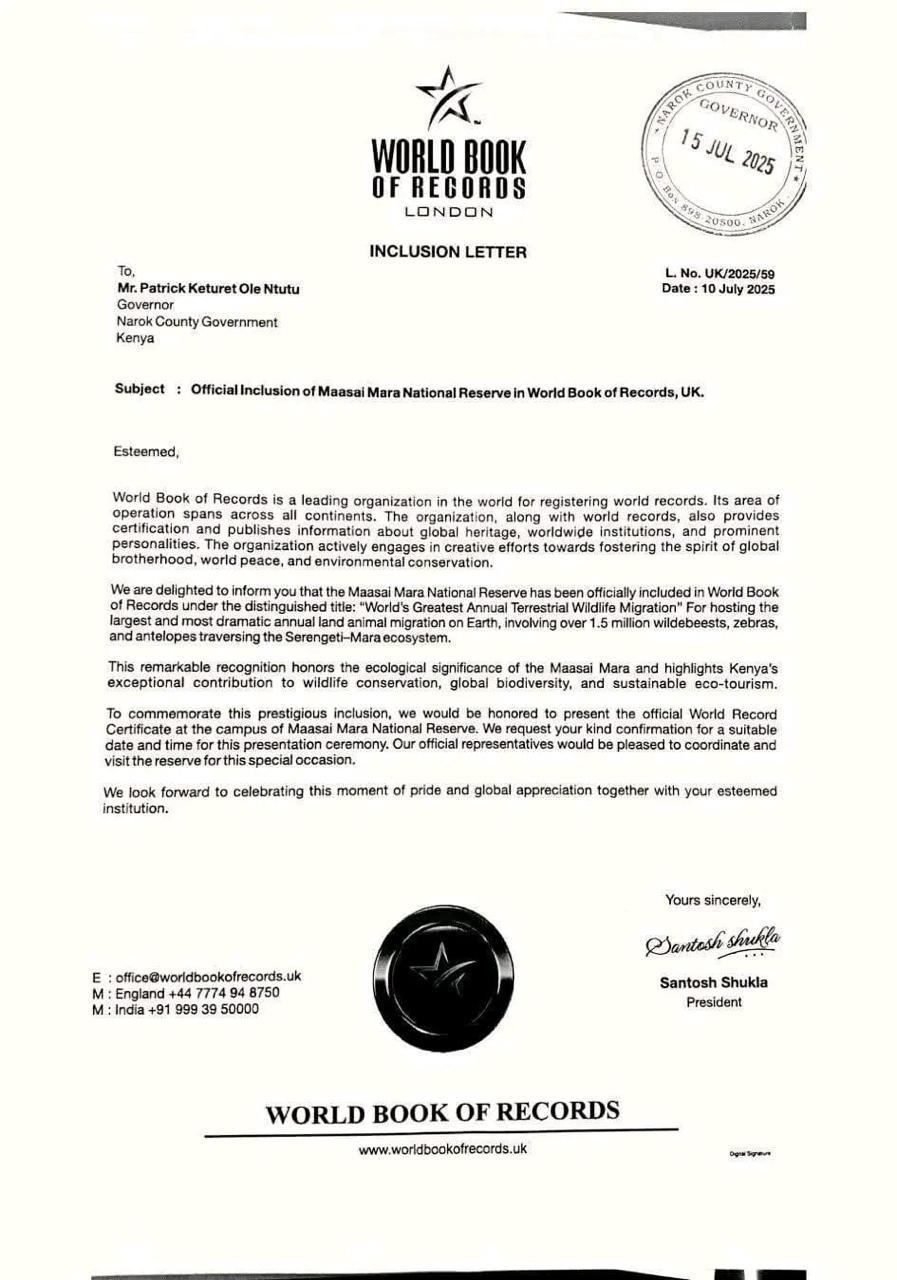
Maasai Mara National Reserve in Narok County, Kenya, achieved a historic milestone by being officially included in the World Book of Records (UK) under the prestigious title “World’s Greatest Annual Terrestrial Wildlife Migration.” This recognition celebrates the reserve’s role in hosting the largest and most dramatic annual land animal migration on Earth, involving over 1.5 million wildebeests, zebras, and antelopes traversing the Serengeti-Mara ecosystem.
The accolade, announced in a letter to Narok Governor Patrick Ole Ntutu by World Book of Records President Santosh Shukla, underscores Kenya’s leadership in global biodiversity conservation and sustainable eco-tourism. This article explores the significance of this achievement, the ecological and cultural importance of the Maasai Mara, the reforms that paved the way, and the implications for Kenya’s tourism and conservation sectors.
The Maasai Mara National Reserve, spanning approximately 1,510 square kilometers in southwestern Kenya, is globally renowned for the Great Migration, a breathtaking spectacle that sees over 1.5 million wildebeests, 200,000 zebras, 500,000 Thomson’s gazelles, 97,000 topi, and 18,000 elands move in a cyclical journey between the Maasai Mara and Tanzania’s Serengeti National Park. This migration, driven by the search for fresh grazing lands and water, peaks between July and October when the herds cross the Mara River into Kenya, facing perilous river crossings fraught with predators like crocodiles and lions. The migration’s scale, complexity, and ecological significance have earned it a place among the Seven Natural Wonders of Africa and recognition as one of the world’s ten wonders.
The World Book of Records’ recognition highlights the migration’s role as “the largest and most dramatic annual land animal migration on Earth,” a phenomenon that draws thousands of tourists annually and plays a critical role in maintaining ecological balance in the East African region. The migration is not merely a movement of animals but a testament to nature’s resilience, with herds calving between January and March and embarking on their journey as the dry season prompts a northward trek. The “endless grey river of life,” as described by safari operators, is a pulsating display of survival, instinct, and interconnectedness, captivating visitors and researchers alike.
A Milestone for Kenya’s Conservation Efforts
The inclusion of the Maasai Mara in the World Book of Records is a testament to Kenya’s commitment to preserving its natural heritage. Narok Governor Patrick Ole Ntutu, upon receiving the letter from Santosh Shukla, described the recognition as a “proud moment for Kenya, for Narok County, for our conservation partners, and for all who cherish the Maasai Mara.” He credited the achievement to strategic reforms implemented since his administration took office in 2022. These reforms include the enactment of the Maasai Mara National Reserve Management Plans, modernization of ranger operations, construction of access roads, and the deployment of smart conservation tools for real-time ecological monitoring. These efforts have restored the reserve’s ecological integrity and elevated its global stature.
Tourism and Wildlife Cabinet Secretary Rebecca Miano echoed Ntutu’s sentiments, calling the accolade a “historic milestone” for Kenya’s tourism and conservation sectors. In a statement on X, Miano emphasized that the recognition reaffirms the Maasai Mara as a natural wonder of the world, crediting President William Ruto’s leadership as “Tourism Ambassador 001” and the dedication of Narok County and local communities. She noted that the migration is “not just a breathtaking spectacle—it is a profound symbol of ecological balance, resilience, and the interconnectedness of nature.” Miano’s remarks underscored the collaborative efforts between the government, local communities, and conservation partners in preserving the reserve’s biodiversity, which supports over 25% of Kenya’s wildlife.
The Maasai Mara: A Biodiversity Hotspot
Established in 1961 as a wildlife sanctuary and later expanded to a game reserve under the management of the Narok County Council, the Maasai Mara is a critical component of the Greater Mara-Serengeti ecosystem, which spans 25,000 hectares across Kenya and Tanzania. The reserve is home to the “Big Five” (lion, leopard, elephant, buffalo, and black rhinoceros) and a diverse array of wildlife, including cheetahs, hyenas, giraffes, and over 400 bird species. Its black rhino population, unaffected by translocations, is one of the largest in Africa, despite being severely depleted by poaching in the 1970s and 1980s. The Mara’s open grasslands, riverine forests, and acacia-dotted landscapes provide an ideal habitat for these species, making it a premier safari destination.
The reserve’s ecological significance extends beyond the migration. It serves as a vital wildlife corridor, supporting the health of the entire ecosystem by facilitating mating and grazing. Programs like the Mara Predator Conservation Programme and the Mara-Meru Cheetah Project monitor lion and cheetah populations, ensuring their survival amidst human-wildlife conflicts and habitat pressures. The Mara River, along with its tributaries, sustains the ecosystem, though challenges like land subdivision in surrounding Maasai pastoral ranches threaten long-term sustainability.
The Maasai people, the region’s indigenous inhabitants, play a crucial role in conservation. Their semi-nomadic lifestyle and traditional knowledge have helped preserve the Mara’s integrity, with many Maasai serving as expert safari guides and camp managers. Cultural experiences, such as visits to traditional manyattas, allow tourists to engage with Maasai customs, further enriching the reserve’s appeal.
Reforms and Innovations Driving Success
Since 2022, Narok County’s administration has implemented transformative reforms to enhance the Maasai Mara’s ecological and tourism value. Governor Ntutu highlighted initiatives such as enhanced ranger deployment, improved infrastructure, and anti-poaching measures. The adoption of tech-based solutions, including real-time ecological monitoring, has bolstered conservation efforts, while road upgrades have improved access for tourists. Chief park warden Stephen Ole Minis reported a surge in bookings, with over 350,000 tourists expected during the 2025 migration season, reflecting the reserve’s growing global appeal.
The Mara Triangle, managed by the Mara Conservancy, exemplifies successful public-private partnerships. Covering the western third of the reserve, the Triangle benefits from modernized operations and community engagement, ensuring sustainable management. These efforts have not only preserved the Mara’s biodiversity but also elevated its status as a model for conservation-led tourism.
Global Recognition and Tourism Impact
The World Book of Records’ recognition, announced on July 15, 2025, has amplified the Maasai Mara’s global profile. The organization, known for certifying extraordinary feats since 2017, praised the reserve’s contribution to “global brotherhood, peace, and environmental preservation.” A formal presentation ceremony is planned at the reserve, with officials requesting Ntutu to confirm a suitable date. This event is expected to draw international attention, further boosting Kenya’s tourism sector.
Tourism is a cornerstone of Kenya’s economy, and the Maasai Mara is a flagship destination. The reserve’s inclusion in the World Book of Records is poised to attract eco-conscious travelers seeking authentic, nature-based experiences. Posts on X reflect public excitement, with users like @ItsMutai noting that the recognition will drive an “influx of tourists” and validate Narok County’s management efforts. The accolade aligns with Kenya’s broader agenda to promote sustainable tourism, with Miano emphasizing the Ministry’s commitment to collaborating with partners to protect the Mara’s fragile ecosystem.
The Maasai Mara offers diverse experiences, from game drives and hot-air balloon safaris to cultural visits and guided nature walks. Luxury lodges like &Beyond Kichwa Tembo and Cottar’s 1920s Safari Camp provide world-class accommodations, while eco-friendly camps cater to budget travelers. The peak migration season (July to October) sees high demand, with operators advising bookings a year in advance. Off-peak seasons, such as the short rainy season (November to December), offer lush landscapes and fewer crowds, ideal for birdwatching and cost-conscious travelers.
Challenges and Future Prospects
Despite its success, the Maasai Mara faces challenges, including land subdivision, human-wildlife conflict, and poaching pressures. The subdivision of Maasai pastoral ranches has weakened regulatory systems, threatening the ecosystem’s integrity. Conservationists call for stronger policies to balance community needs with wildlife preservation. Additionally, climate change impacts, such as unpredictable rainfall patterns, could disrupt the migration cycle, necessitating adaptive management strategies.
The World Book of Records listing is a catalyst for addressing these challenges. It reinforces the need for continued investment in conservation, community engagement, and infrastructure. Defense Cabinet Secretary Soipan Tuya described the recognition as a “major boost” to Kenya’s wildlife conservation and safari tourism efforts, while international media, such as China Daily, hailed the Mara as a “shared heritage of humanity.” The accolade is expected to spur partnerships with global conservation organizations and increase funding for initiatives like the Angama Foundation’s Greatest Maasai Mara Photographer of the Year competition, which raises funds for conservation.
A Global Invitation
Governor Ntutu extended a warm invitation to the world: “Come and witness this marvel of nature with us. Visit the Maasai Mara, where every crossing is a testament to life’s resilience.” This call, echoed by Miano’s “Karibu Kenya, Karibu Maasai Mara!” underscores the reserve’s universal appeal. The recognition not only celebrates the Great Migration but also honors the Maasai people, rangers, and conservationists who have safeguarded this ecological marvel.
As Kenya prepares to co-host the 2027 AFCON and continues to promote its tourism sector, the Maasai Mara’s listing in the World Book of Records positions it as a global icon. The reserve’s golden savannahs, teeming with wildlife and steeped in cultural heritage, remain a testament to the power of collective stewardship. This milestone is not just a win for Kenya but, as Miano aptly stated, “a win for the planet.”
Former Kiambu Governor Ferdinand Waititu has secured a major bail reprieve from the High Court, with Justice Winfrida Okwany reducing his bail from Sh53.5 million to Sh20 million cash pending appeal in his ongoing corruption case.
President Ruto and Governor Sakaja signed a cooperation agreement allocating funds for 50,000 new streetlights, water plants saving 50 million litres daily, 27 km Nairobi River sewer and ward road upgrades, with Ruto calling it a partnership to make the city livable while opposition senators warn of devolution threats.
A staff member at Moi Teaching and Referral Hospital allegedly stole Sh10 million by falsifying patient bills as paid in the eCitizen system while diverting the money to her personal account, prompting an ongoing police and hospital investigation.