On a vibrant morning in Kipkeikei, Trans Nzoia County, Deputy President Kithure Kindiki stood before a crowd of over 3,000 women at the Cherangany Constituency Economic Empowerment Forum on July 11, 2025, delivering a message of hope and economic transformation. Hosted at the Kipkeikei Secondary School grounds, the event brought together women’s groups, SACCOs, and local leaders to discuss strategies for financial independence and resilience in a region known as Kenya’s maize breadbasket. Joined by National Assembly Speaker Moses Wetangula, Cherangany Woman Representative Lilian Siyoi, and other prominent leaders, Kindiki emphasized the Kenya Kwanza administration’s commitment to uplifting women through initiatives like the National Youth Opportunities Towards Advancement (NYOTA) and Kenya Jobs and Economic Transformation (KJET). “This is not about politics; it’s about empowering our mothers and sisters to thrive,” Kindiki said, addressing the enthusiastic crowd. “Your businesses, your SACCOs, are the backbone of our economy.”

The forum, held in the heart of Cherangany Constituency, was a testament to Trans Nzoia’s growing role as a hub for economic diversification. Despite producing nearly 40 percent of Kenya’s maize, the county grapples with a 36 percent poverty rate, a paradox that has driven efforts to promote alternative livelihoods like avocado farming and small-scale enterprises. The event focused on equipping women with resources and skills to navigate economic challenges, including access to affordable credit, market linkages, and agricultural training. Kindiki highlighted the government’s Bottom-Up Economic Transformation Agenda, which prioritizes micro and small enterprises as engines of growth. “Women are the heartbeat of our communities,” he said. “When we empower you, we empower families, villages, and the nation.” The crowd erupted in applause as he announced plans to construct modern markets with facilities like cold rooms and ICT hubs to support women traders.
Cherangany Woman Representative Lilian Siyoi, a key organizer, described the forum as a milestone for women in a region where traditional farming has struggled against climate change and market volatility. “Our women are ready to move beyond maize,” Siyoi said, referencing the Golden Hass Avocado Project, which has distributed over 3,000 seedlings to local farmers. “We’re giving them tools to succeed—seeds, training, and markets.” The project, supported by Trans Nzoia Senator Allan Chesang, aims to connect women farmers to lucrative export markets, building on the success of Kenya’s avocado industry, which earned KSh15 billion in 2024. Chesang, present at the forum, praised the initiative, saying, “This is about self-reliance. Our women will lead the way in making Trans Nzoia a hub for agro-industrialization.”
The event drew a diverse group of leaders, including National Assembly Majority Leader Kimani Ichung’wah, Senate Majority Leader Aaron Cheruiyot, and MPs like Farouk Kibet and Doris Donya. Their presence underscored the government’s push for inclusive development, a response to criticisms from opposition leaders who have labeled such forums as early election campaigns. Kindiki dismissed these claims, emphasizing that the government’s focus is on delivering tangible benefits now, not in 2027. “We’re not here to campaign,” he said firmly. “We’re here to stand with mama mboga, boda boda riders, and women entrepreneurs who need support today.” He cited the construction of 15 modern markets in Machakos and similar projects in Trans Nzoia as evidence of the administration’s commitment to grassroots development.
The forum addressed pressing local issues, including the high cost of living and limited access to farm inputs. Kindiki outlined government efforts to subsidize fertilizers, which have boosted tea, coffee, and milk prices, benefiting Trans Nzoia’s dairy farmers. “Agriculture remains our economic backbone,” he said, noting that milk prices in the region have risen by 20 percent since 2023. “We’re ensuring farmers get fair returns.” He also announced plans for a Jitume Lab in Kipkeikei, aimed at bridging the digital divide for women entrepreneurs through ICT training. Local trader Esther Wanjiku, who runs a vegetable stall in Kitale, shared her excitement. “This lab will help me learn how to sell online,” she said. “I want to reach customers beyond Trans Nzoia.”
The event was not without its challenges. Recent protests in Trans Nzoia, including a demonstration in Kipsongo over land grabbing, have highlighted tensions around resource allocation. Kindiki addressed these concerns, urging unity and peaceful resolution of disputes. “We cannot progress if we’re divided,” he said, echoing his remarks in Tana River earlier in July. “Trans Nzoia is for all Kenyans, and we’ll ensure every community benefits from development.” His call for cohesion resonated with attendees, many of whom have faced economic hardships exacerbated by a 67 percent youth unemployment rate and a national debt of KSh11.36 trillion. “The government is listening,” said Mary Chebet, a SACCO member. “But we need these promises to turn into reality.”
Pastor Jane Kamau, a local community leader, shared a personal story of how SACCOs transformed her life, enabling her to start a poultry business. “Five years ago, I had nothing,” she said, addressing the crowd. “Today, my children are in school because of women’s groups like these.” Her testimony underscored the forum’s focus on empowering women through collective savings and credit schemes. The event included the distribution of seed capital to 20 women’s groups, each receiving KSh200,000 to expand their businesses. “This money will help us buy more stock and grow,” said Grace Wamalwa, a beneficiary who runs a tailoring shop. “We’re grateful to the Deputy President and our leaders.”
The forum also tackled gender-based violence (GBV), a growing concern in Trans Nzoia, where county statistics report an 18 percent prevalence rate. Kindiki announced plans for a safe house for GBV survivors, included in the County Integrated Development Plan. “We cannot empower women economically if they’re not safe,” he said, drawing cheers from the crowd. County Director of Gender Robert Kibii, present at the event, emphasized the need for community training to curb GBV, particularly in informal settlements like Kipsongo and Shanti. “This forum is a step toward holistic empowerment,” Kibii said. “Safety and economic freedom go hand in hand.”
The event’s timing, amid nationwide protests sparked by the death of blogger Albert Ojwang and the shooting of mask vendor Boniface Kariuki, added a layer of urgency. Kindiki addressed the unrest, calling for peaceful demonstrations and reiterating the government’s commitment to national security. “Express your views, but do it within the law,” he urged, referencing the 31 deaths during the July 7 Saba Saba protests. His remarks drew mixed reactions, with some attendees like John Ndiema, a boda boda rider, expressing frustration. “We want jobs and lower prices, not just forums,” he said. Others, however, praised Kindiki’s engagement. “He’s here, listening to us,” said Agnes Wanyonyi, a maize farmer. “That’s more than we’ve seen from some leaders.”
Trans Nzoia Governor George Natembeya, though absent, sent a message of support, emphasizing the county’s vision to become an agro-industrialized hub. “Empowering women is key to our development,” his statement read, aligning with the forum’s goals. The event also highlighted infrastructure projects, such as the planned upgrade of Kipkeikei dispensary to a health center and improvements to auction yards, addressing demands raised during recent public participation forums. “We’re acting on your input,” Kindiki assured, citing the county’s 2025-2026 development plan.
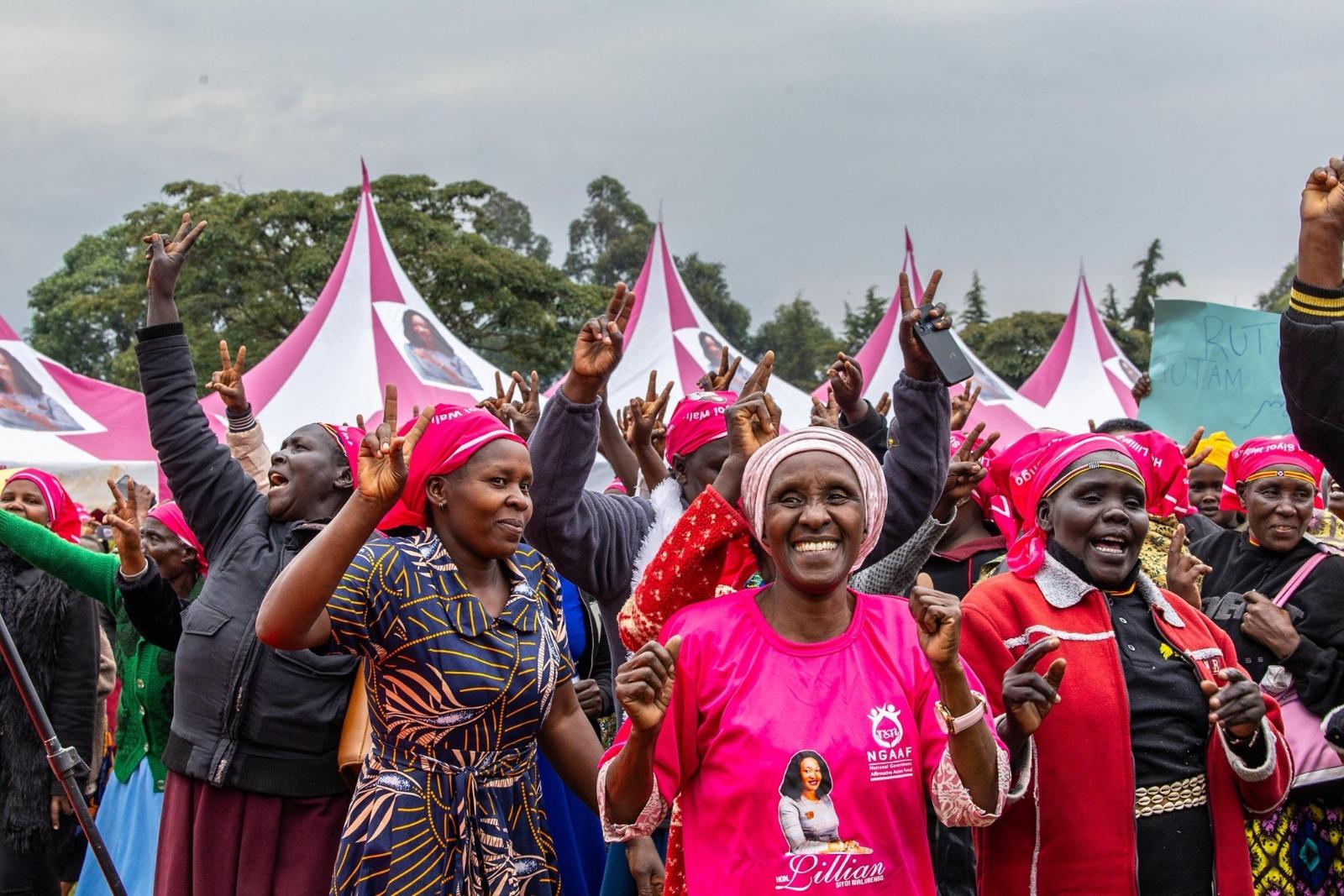
As the forum concluded, women danced to traditional Kalenjin and Luhya tunes, celebrating the promise of a brighter future. Kindiki and Wetangula joined in, symbolizing unity in a region known for its diverse communities. “This is what Kenya should be—together, working for progress,” Wetangula said, addressing the crowd. The event, attended by over 3,000 women from across Cherangany’s seven wards, marked a significant step in mobilizing grassroots support for economic inclusion. For many, like trader Monica Wairimu, the forum offered hope. “I’ve struggled to grow my business,” she said. “Today, I feel like we have a chance to succeed.”
The Kipkeikei forum is part of Kindiki’s broader economic empowerment drive, following similar events in Kisii, Kitui, and Tana River. With Kenya facing economic and political challenges, the Deputy President’s focus on women’s empowerment signals a strategic push to strengthen the grassroots economy. As the women of Cherangany return to their businesses and farms, they carry with them renewed optimism and a call to action: to seize the opportunities presented and hold leaders accountable for their promises.