A significant opportunity emerged for professionals across Kenya on Tuesday, July 29, 2025, as the Social Health Authority (SHA) unveiled plans to recruit individuals for 64 senior management positions within the state corporation. The announcement, made public at 10:30 AM East Africa Time through an official notice, signals a push to bolster the organization’s capacity as it works to implement its mandate under the Social Health Insurance Act of 2023. Interested candidates are directed to visit the SHA website at recruitment.sha.go.ke for detailed job descriptions, with applications accepted until 5:00 PM on August 19, 2025. “This is a chance for skilled Kenyans to shape our healthcare future,” a senior SHA official said during a brief address to the media in Nairobi. The move has sparked interest among job seekers and sparked conversations about the evolving health sector.
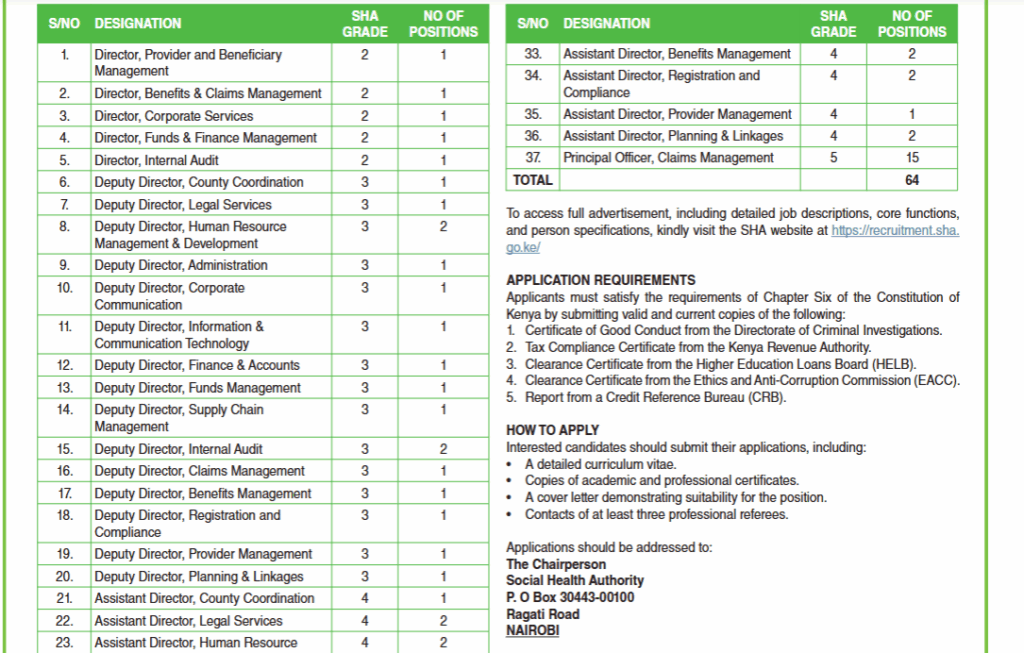
The SHA, established to provide financial risk protection and facilitate equitable access to quality healthcare, administers the Social Health Insurance Fund, Primary Healthcare Fund, and Emergency, Chronic, and Critical Illness Fund. The recruitment drive aims to strengthen its leadership team as it transitions from the former National Hospital Insurance Fund (NHIF) framework, absorbing staff and expanding services nationwide. The 64 positions span various departments, including finance, human resources, legal services, and claims management, reflecting the organization’s broad operational needs. A teacher in Kisumu, preparing lessons, remarked, “This could be a big step for healthcare if the right people join.” The deadline of August 19 provides a three-week window for applications, encouraging a competitive selection process.
Public response has been a mix of enthusiasm and curiosity. In Mombasa, a shopkeeper serving customers listened to the news on a radio, saying, “I hope they hire people who care about patients.” In Nakuru, a farmer tending his maize fields heard the update, adding, “Good jobs are welcome, but they must reach rural areas too.” The SHA has outlined a rigorous application process, requiring candidates to submit detailed curricula vitae, academic and professional certificates, and a cover letter demonstrating suitability. Applicants must also provide clearance certificates from the Directorate of Criminal Investigations, Kenya Revenue Authority, Higher Education Loans Board, Ethics and Anti-Corruption Commission, and a Credit Reference Bureau report. A youth leader in Naivasha, organizing a community meeting, noted, “The requirements are strict, but that’s how you get the best.”
The recruitment follows recent developments within SHA, including the absorption of former NHIF staff and efforts to stabilize operations amid public scrutiny over service delivery. The corporation encourages former NHIF employees to use existing accounts on the recruitment portal rather than creating new ones, streamlining the process for those familiar with the system. The roles demand a minimum of 15 years of cumulative work experience, with at least five years in senior management, underscoring the need for seasoned leaders. A driver in Garissa, fueling his matatu, said, “If they hire experienced people, it might improve things at the clinics.” The initiative aligns with the government’s push for universal health coverage, a priority amid economic challenges like a Sh10 trillion public debt and 5.5% inflation.
Communities across Kenya have begun discussing the opportunities. In rural Kitale, a herder paused to hear a radio broadcast, saying, “This could bring jobs to our youth if they qualify.” In urban Eldoret, a student at a cyber cafe scrolled through updates, adding, “I’ll check the website; it sounds promising.” The SHA building on Ragati Road in Nairobi serves as a physical drop-off point for applications, with envelopes clearly marked with the applied position. The online portal at recruitment.sha.go.ke offers detailed job descriptions, ranging from directors overseeing claims management to deputy directors handling legal and administrative functions. A mother in Nyeri, feeding her children, expressed hope. “If they hire well, it could help our hospitals,” she said, clearing the table.
The morning’s announcement drew attention from diverse groups. In Thika, a father waiting at a clinic said, “My cousin might apply; he’s got the experience.” In Baringo, a community elder leading a discussion noted, “We need leaders who understand our needs.” The SHA emphasizes diversity and gender equality in its hiring process, a commitment reflected in its call for applications from all qualified individuals. The roles require proficiency in computer applications and demonstrated merit, with some positions necessitating specific qualifications like legal practice certificates or leadership course completions. A health worker in Kisii, coordinating a vaccination drive, added, “This could bring fresh ideas if they pick the right team.”
As the day progressed, the story spread to remote regions. In Marsabit, a herder listening to a radio update said, “Jobs like these could change our area.” In Mombasa’s markets, a vendor packing fish asked, “Will they train people who aren’t experienced enough?” The SHA has warned against canvassing, stating it will lead to automatic disqualification, ensuring a fair process. The August 19 deadline provides ample time for preparation, with the corporation planning to contact only shortlisted candidates. A youth leader in Naivasha, reflecting on the news, said, “This is a big moment for healthcare careers in Kenya.” The recruitment portal’s accessibility, both online and physically, aims to include applicants from varied backgrounds.
The afternoon brought a reflective mood to offices and homes. In Eldoret, a public servant preparing a report said, “These jobs could stabilize SHA if filled right.” In Kisumu, a mother checking on her family added, “I hope they consider local talent.” The SHA’s mandate to collaborate with stakeholders, including healthcare providers and government agencies, requires a robust management team, making the recruitment a critical step. The process mirrors past efforts to enhance institutional capacity, though public trust hinges on transparent selection. A community organizer in Turkana, planning a radio talk, remarked, “We’ll watch to see who gets chosen.” The initiative underscores a broader effort to professionalize health administration.
Economic pressures, including rising costs of living, frame the recruitment’s importance. The SHA aims to ensure efficient fund management and service delivery, with senior managers playing a pivotal role. A lawyer in Nairobi, discussing over tea, noted, “Experienced leaders can turn SHA around if given the chance.” The application requirements, including Chapter Six compliance, aim to uphold integrity, a concern following past NHIF controversies. A vendor in Timau, closing his stall, said, “Let’s hope they hire people who won’t waste our money.” The recruitment’s success could set a precedent for future state corporation staffing, influencing healthcare outcomes.
The evening saw continued engagement across the country. In Nakuru, a group at a market debated the news. “Will these jobs pay well?” one trader asked, sorting vegetables. In Nairobi’s cyber cafes, a student scrolling through updates noted, “People are excited about applying.” The SHA plans to review applications meticulously, with the August 19 cutoff marking the end of the initial phase. A youth leader in Kitale, organizing an event, reflected, “This could open doors for many if done fairly.” As Kenya watches, the recruitment process offers a glimpse into the future of its health authority, balancing opportunity with the need for competent leadership.